Kathmandu to Bhairahawa Bus 2026: Ticket Price, Timings, Route & Lumbini Guide
Bhairahawa is a border town that does three jobs at once. It is the gateway to Lumbini. It is Nepal's busiest western crossing into India. And it is home to Gautam Buddha International Airport, the country's second international airport.
That combination means the Kathmandu to Bhairahawa bus carries an unusually mixed crowd. Pilgrims heading to the Buddha's birthplace. Indian travellers coming and going through Sunauli. Nepali families from Rupandehi. Backpackers on their way to Varanasi. Traders. Students. It is one of the more interesting buses to be on, and one of the most heavily served corridors out of the capital.
Here is what the journey costs, how long it takes, and what has changed in 2026.
Kathmandu to Bhairahawa at a glance
Road distance | Roughly 265–285 km via the Prithvi and Mahendra Highways |
Typical journey time | 9–11 hours for most coaches; some faster services around 7–8 hours, some slower ones 13–14 hours |
Fare range | Around Rs. 1,300 – Rs. 1,600 depending on coach type |
Departures | Both day and night — the route runs from early morning to late evening |
Official name of the town | Siddharthanagar Municipality, Rupandehi District, Lumbini Province |
Distance to Lumbini | About 22 km west |
Distance to the Indian border | About 4 km south to Belahiya–Sunauli |
Best months | October to March |
Kathmandu to Bhairahawa bus fare in 2026
Fares on this route sit roughly between Rs. 1,300 and Rs. 1,600, which makes it one of the better-value long routes out of Kathmandu given the distance.
Rs. 1,300 – 1,400 gets you a standard 2×2 sofa seater or deluxe coach. Reclining seats, no air conditioning on the cheaper units, and a water bottle included on most services. These are the workhorses of this route, running both day and night.
Rs. 1,400 – 1,500 covers AC coaches and the day Hiace services. Sealed cabin, better seats, usually charging points and a screen.
Rs. 1,500 – 1,600 buys a VIP sofa seater or a coach with a sleeper option — wider seats, deeper recline, more legroom. These run at both ends of the day, though the premium overnight services cluster at the top of this band.
A useful quirk of this route: because Bhairahawa sits so close to Lumbini, some services are marketed and priced as Kathmandu to Lumbini rather than Bhairahawa. They are effectively the same journey with a different final 22 km. If you are going to Lumbini specifically, it is worth checking both before you book, because the pricing is not always identical.
Fares climb during Dashain and Tihar, and again around Buddha Jayanti in May, when Lumbini sees a genuine pilgrimage surge and the whole corridor fills up. Our guide to booking during the festival rush covers how far ahead to plan.
How long does the journey take?
9 to 11 hours covers most services on this route, with a handful running faster around 7 to 8 hours and a smaller number of slower schedules stretching to 13 to 14 hours.
That is a wider spread than a lot of route guides let on, and it is worth understanding why. It is less about day versus night than it is about how many stops a given service makes and which operator's schedule you have booked — two coaches leaving Kathmandu an hour apart, on the same road, can post quite different durations. If arrival time matters to you, check the specific service's stated duration rather than assuming a flat number for the whole route.
The main variables are the Mugling–Narayanghat stretch, which is the single most congested section of the whole route, and the Daunne hills between Narayanghat and Butwal, where trucks crawl and overtaking is slow.
In monsoon, add two to three hours and expect the possibility of longer delays. The Narayanghat corridor and the Daunne section are both landslide-prone.
The route: what you pass
Almost all Bhairahawa services take the same road, and it is one of the more scenic long-distance runs in the country.
Out of Kathmandu at Thankot and over the Nagdhunga pass, then down the Prithvi Highway alongside the Trishuli River, past the rafting put-ins and riverside camps. At Mugling, the road forks — Pokhara-bound traffic goes right, and you go left toward Narayanghat.
From Narayanghat the highway runs west along the edge of the Chitwan plain, then climbs into the Daunne hills — a short, twisting, truck-heavy section that everyone remembers. Down the far side into the Terai proper, through Butwal, and finally the flat straight 22 km south to Bhairahawa.
Most buses break at Malekhu, Mugling or Narayanghat. Malekhu is famous for its fried river fish, which is worth the stop even if you were not hungry.
One genuine change in 2026: the Nagdhunga tunnel
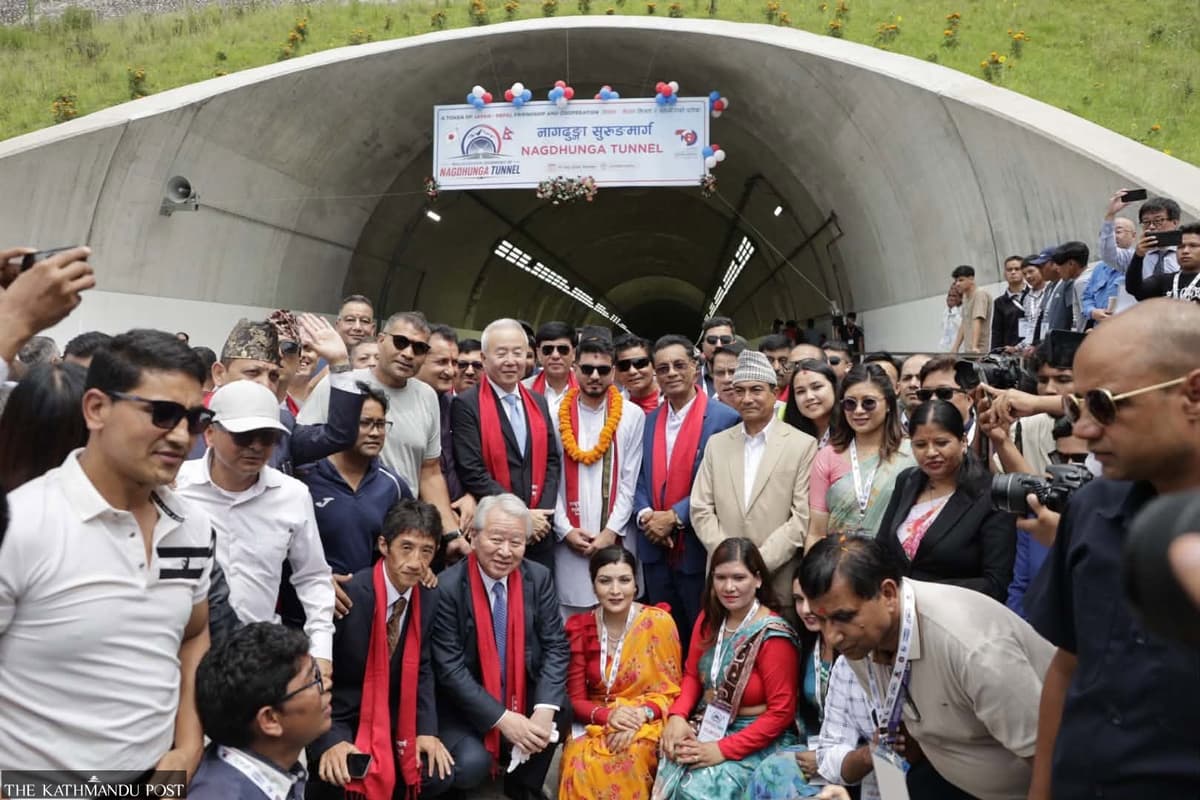
The Nagdhunga–Sisnekhola tunnel — Nepal's first modern road tunnel — was formally inaugurated on 27 July 2026, seven years after its foundation stone was laid. It runs about 2.7 km beneath the Nagdhunga hills on exactly this route, at the western gateway out of Kathmandu.
Here is the honest part, because you will see plenty of coverage that skips it: the tunnel is opening in phases, not all at once. The first stage is a trial period, and initial access is restricted to emergency vehicles — ambulances, fire engines and security vehicles. Buses are not using it yet.
Tolls have already been approved, with buses and standard trucks set to pay Rs. 260 entering Kathmandu and Rs. 200 heading out. Pedestrians, motorcycles, three-wheelers and non-motorised vehicles are permanently barred, as are vehicles carrying fuel, gas or explosives.
Once buses are admitted, the Nagdhunga climb — currently 30-odd minutes of grinding traffic — is expected to drop to a matter of minutes. That is a real improvement on a route where the first hour out of Kathmandu has always been the most frustrating part. But it has not happened yet, and anyone telling you your Bhairahawa bus is already faster because of the tunnel is ahead of the facts.
Boarding and dropping points
In Kathmandu, most Bhairahawa services leave from New Bus Park (Gongabu), with Kalanki as the second major pickup — convenient since it is already on the westbound road. A smaller number use Balaju.
In Bhairahawa, the main terminal is the Bhairahawa bus park, close to the town centre. Buses continuing to Lumbini or the border will drop at additional points along the way — confirm with the conductor which one applies to you.
For the border, the crossing at Belahiya on the Nepali side and Sunauli on the Indian side is about 4 km south of Bhairahawa. Rickshaws and taxis run this constantly and cheaply.
Day bus or night bus?
This route genuinely offers both, which is unusual for a long Nepali journey, so it is worth thinking about.
Take a day bus if you want to see the Trishuli valley and the Daunne hills, you are travelling with children, or you are nervous about night driving. Depart around 6 to 7 AM and arrive late afternoon.
Take a night bus if you want to save a day, you are heading straight for the border in the morning, or you can sleep on a coach. Departures cluster in the evening and you arrive early.
For pilgrims going to Lumbini, the day bus usually wins — arriving mid-afternoon gives you time to reach Lumbini and settle before the monastic zone closes.
Bhairahawa, Lumbini and the border
Lumbini is the reason most travellers come this way. The birthplace of the Buddha, a UNESCO World Heritage Site, and one of the four principal Buddhist pilgrimage sites. The sacred garden holds the Maya Devi Temple, the Ashoka Pillar, and the Puskarini pond, surrounded by a large monastic zone where dozens of countries have each built a monastery in their own architectural tradition. It is 22 km from Bhairahawa and easily done as a day trip, though staying overnight is better.
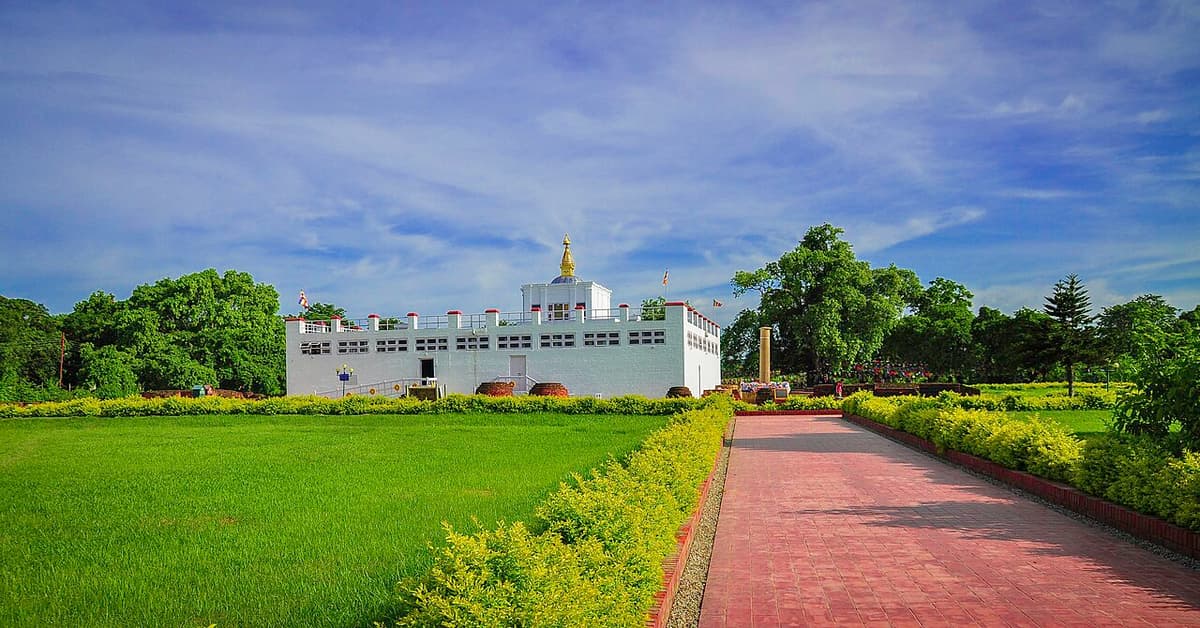
Bhairahawa itself — officially Siddharthanagar — is a working border town rather than a sight. Good food, busy markets, and a genuinely mixed Nepali-Indian character that shows up in everything from the signage to the sweets.
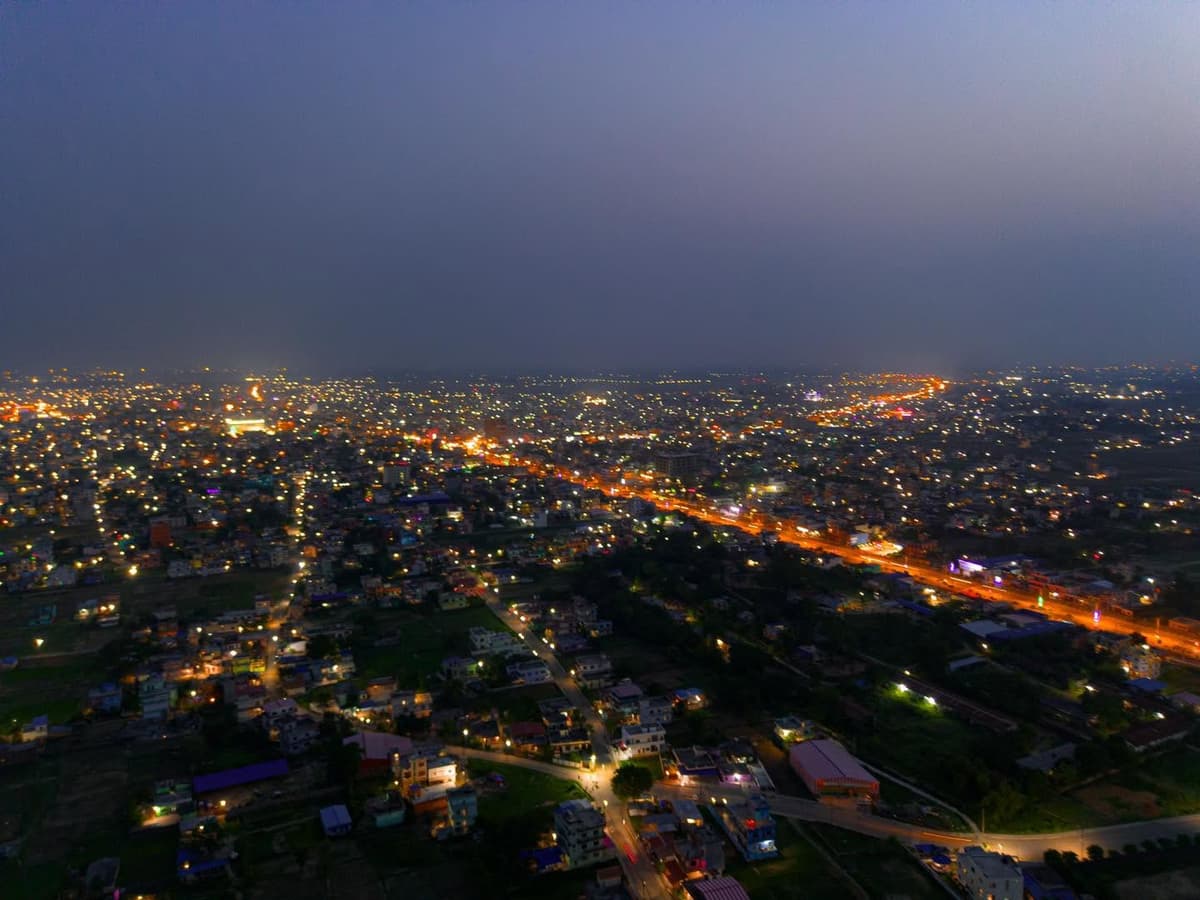
Gautam Buddha International Airport sits just outside town. It is a modern facility that has struggled to attract sustained international traffic since opening in 2022, though scheduled services have gradually returned and the airport is pushing hard to expand. Domestic flights from Kathmandu and Pokhara run reliably.
Visa on arrival is available at Gautam Buddha International Airport for eligible nationalities, with an immigration office handling on-arrival applications. If you are flying in rather than crossing by land, this is a legitimate entry point. Our Nepal visa on arrival guide covers fees, documents and eligibility in detail.
Crossing to India at Sunauli puts you on the road to Gorakhpur, which is the rail junction for Varanasi, Lucknow and Delhi. It is one of the busiest Nepal–India crossings and generally straightforward, though it is worth arriving with time in hand rather than at the end of a long day. Our Kathmandu to Delhi bus guide covers the documentation each nationality needs at this crossing.
Practical tips
Book AC between April and September. Bhairahawa is hot. Genuinely hot. A non-AC coach arriving at midday in May is a bad afternoon.
Sit on the right side going south for the better Trishuli views on the Prithvi Highway stretch.
Carry Indian rupees if you are crossing. Small denominations. Nepali currency is accepted at Belahiya but rates at the border are poor.
Eat at Malekhu. The fried fish is not a tourist trap; it is the actual reason people stop there.
Do not plan a same-day border crossing off a late night bus. Arrive, sleep, cross fresh.
Motion sickness tablets for the Daunne section if you are prone. It is the twistiest part of the route.
Explore Nepal with GoMyGo
Bhairahawa is one of the busiest corridors out of Kathmandu, which is both good and bad news. Good, because there is genuine choice — day and night, budget and premium, direct to Bhairahawa or through to Lumbini. Bad, because during pilgrimage season and festival weeks that choice evaporates fast.
Booking online is the simplest way to see the whole picture at once. GoMyGo shows live availability across the app, on both Android and iOS, and the website, so you can compare a 6 AM day coach against a 7 PM AC sofa service, check where each one boards, and pick your actual seat from a live map rather than accepting whatever is assigned.
Payment covers the full range — eSewa, Khalti, IME Pay, fone Pay, ConnectIPS, Indian UPI and PayPal. That last set matters on this route more than most, given how many travellers book from India or from abroad ahead of a Lumbini trip.
Confirmation arrives by email and SMS immediately, and support is available around the clock on WhatsApp at +977-9704666777 for anything that comes up on the day.
Final Words
The Kathmandu to Bhairahawa bus is one of the country's genuinely well-served routes — reasonable fares, real choice between day and night, and a road that is more interesting than most.
And it is about to get better. The Nagdhunga tunnel opened its first phase on 27 July 2026, and when buses are eventually admitted, the worst hour of this journey simply disappears. It has not happened yet. But for a route that begins with a slow grind up the same hill it has climbed for decades, that is a change worth watching for.
In the meantime: book ahead in pilgrimage season, take the day bus if Lumbini is the goal, and stop at Malekhu.
Frequently Asked Questions
Written by
GoMyGo Team
The GoMyGo team covers Nepal travel, bus routes, booking tips, and everything you need for a smoother journey.